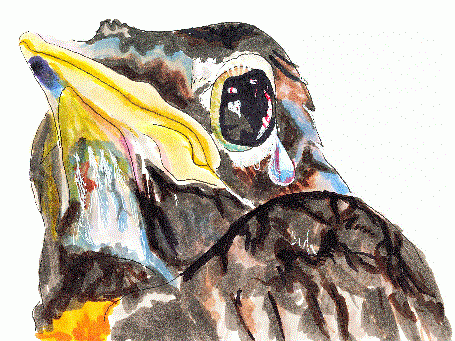
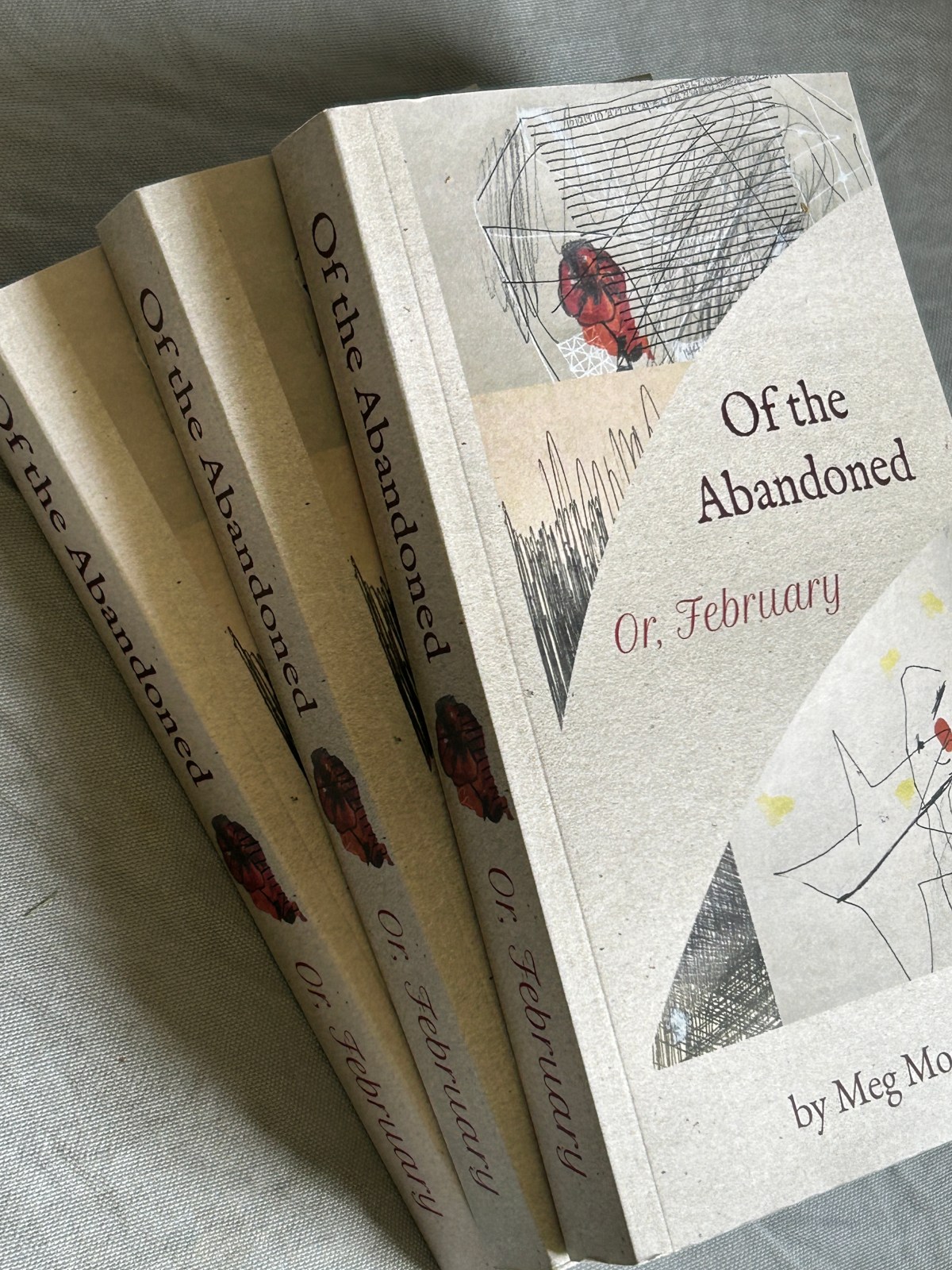
As of August 11, Of the Abandoned, Or, February, the second book in the Evernostian Year (self-published, color-printed, multi-genre, in the same series as Out of Tales but stands on its own) is live. It weaves together vignettes of an archetypal Wanderer going through a void or an allegorical City or people’s minds; a first-grader (Jennie) home alone on a Valentine’s day outside time, inhabiting or inventing tragedies in the lives of people she knows; and the tragedies themselves, which range from paranormal romance gone disastrously wrong to grim realism.
There are a few ways in which this second book is not for the faint of heart (trauma, difficult themes, potentially controversial subjects), such that it earns its content note (supplied by a helpful Claude; I am terrible at calibrating that sort of thing) several times over, but I’m feeling prouder and happier than perhaps such a series of artful nightmares should allow me to.
Last time I checked, it was considered definitional that books in the romance genre should end in a happily-ever-after (HEA) or at least a happily-for-now (HFN). Originally, I’d imagined the book I brought out a week and a half ago — Of the Abandoned, or, February: A Book of Evernost — as primarily an anti-romance, twisting February/Valentine’s Day vibes into bitter satire. It turned out a lot heavier, slightly more hopeful, and (to me, at least) significantly more interesting than that, but a good third of the structure is (be warned) precisely that.
Jennie tries to color worksheets representing the cardinal and theological virtues as she daydreams about doll games with her friends — in particular, love-story obsessed Brook and her subversive, sarcastic best friend Jordan, who prefers shock and black humor always. These daydreams blend — factually? or just in her imagination? we never know — into the real lives of people she barely knows, where women and girls are set up for love (whether by the machinery of paranormal romance or just by circumstance) and it changes (in various ways) to hate and death.
But it’s not just dolls.
Outside the grocery store with a cardboard sign, or walking the paths left by droplets of water slipping down the windowpane, the Wanderer crosses Jennie’s field of view again and again. This Wanderer might be anyone or no one, and the voids and cities they wander are a kind of nowhere.
January plays with the idea of “in” and “out”; February digs into the suffering both can entail — cold or stifling heat, loneliness or torment, exile or bad romance — in the absence of the third thing that makes anything tolerable at all. I keep wanting to say the third thing is love.
Friends have asked me why I wrote a book so full of suffering. There are a few answers, none of them totally satisfying. Is it simply a gross taste for melodrama — is it my inner Jordan, offended by Brook’s longing for a HEA? In my literary tastes — there’s nonzero of that. Is it, conversely, that reality just feels this way to me? Nonzero of that too — people, ranging from normal to good to very troubled, coping with bad things are a fact of both literature and life; happy endings are not how I process what I see of the world, on the whole. But there’s another, clearer, happier reason that emerged: I’m building the rescue.
My first book in my year-based Evernost series, Out of Tales, is abstract, experimental, and a very long introduction (as signaled by multiple chapters or sections titled introduction) to Evernost. Most, maybe all, of its text is free at dreamswithopeneyes.itch.io/jennies-room. The net art associated with February (well underway, hoped to land next year) is going to be different: complementary and aimed at redemption — the…user? reader? player?…will be tasked with saving Jennie from Bad Ending World, the place through the mirror where everything turns out wrong, whether by tidying a cluttered house that is secretly Brook’s dollhouse or by exploring the gray void outside the window or by doing the Evernostian version of Jennie’s first-grade homework.
In other words, the darkness in some sense exists to be redeemed, to show that no darkness is permanent and absolute, to provide darkness to set off the light that is coming. Is the dualism of that, that we need darkness to know the light, a troubling formulation? Deeply. Jennie finds it troubling. My narrator in Out of Tales finds it troubling. Readers of Augustine (who, iirc, proposed the fact that darkness and light are requisite for an artistic composition as an explanation for a hell of eternal conscious torment) have found it troubling for centuries.
I hope, uncertainly, that such motives may justify suffering in fiction, at least. I also hope that the redemption I write and draw and code will be real and earned.

