
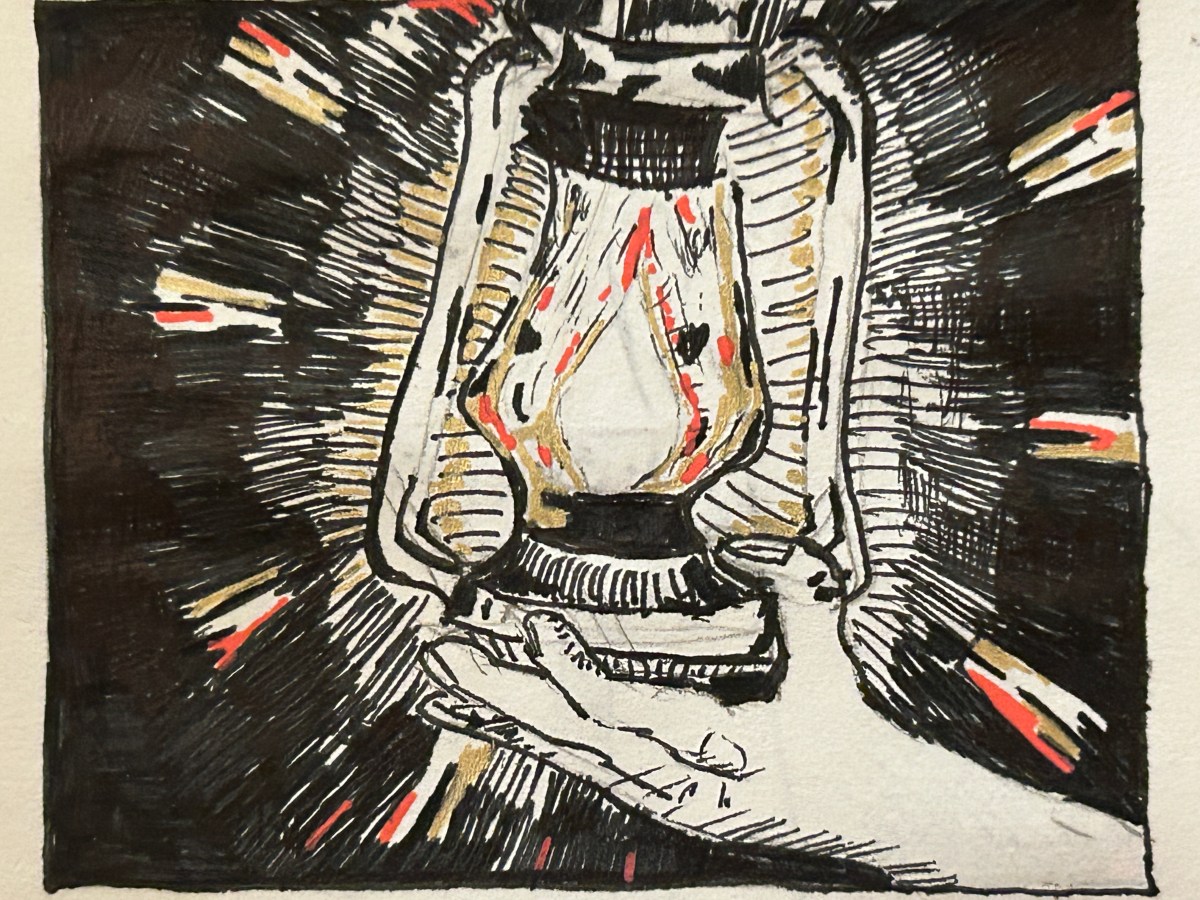
Warren Tusk and I have been friends and exchanged writing for more than a decade, and I remain enormously grateful not only for many intellectual exchanges but also for his feedback and encouragement as both of us find our way (at long last) into the world of traditional publishing. In the book this interview discusses (The Goetist), a riff on or response to Kahlil Gibran’s The Prophet, a demon expounds on his philosophy of life to the magician who summoned him. It’s startling, startlingly relatable, and, to my eye, at least, brilliant. The Goetist will be released by Apocryphile Press on January 5, but it’s available for preorder here: https://www.amazon.com/Goetist-Warren-Tusk/dp/196564631X, or if you’re interested in a free review copy, check out https://booksprout.co/reviewer/review-copy/view/240715/the-goetist.
The Prophet, which I understand is the major inspiration for the form of The Goetist, exists somewhere among self-help, philosophy, and poetry. You embrace whatever genre that is, complete with words like “unto” that sound even stranger in a contemporary setting than they did a century ago when The Prophet was published, and then add to it “occult mysteries.” Why this form in particular?
Glib answer:
Because of course I despise the trappings of worldly success – as you can surely tell from the text – and so I endeavor to make my writing as staggeringly un-marketable as possible.
(This is not actually true, but…I sure wouldn’t blame anyone for believing it.)
Serious answer:
Because The Goetist is a painfully earnest kind of book. It’s me looking into the camera and shouting, “I have important things to say! You should take me very seriously!”
And trying to say important things, in lucid normal accessible prose, is actually really hard. At least, it’s really hard for me. You always want to establish more and more background knowledge; you always want to define your terms with more and more specificity; you always want to cover more and more edge cases; you always want to preemptively answer more and more objections; and soon enough you’ve used a hundred thousand words to make a single not-that-complicated point, and no one will ever want to read it.
The poetry, and the grandiose demoniacal metaphor, are freeing. You can use some cool highflown words to just say what you want to say, and if you haven’t rigorously addressed every single ramification of your idea…well, doing that wouldn’t be very cool or highflown, would it?
The Goetist is complex, paradoxical, oracular. It’s also readable and quotable, and it places explicit value on legibility (“In giving shape to yourself, you make it possible for others to understand you; from seething chaos, you create a thing that can be understood”) and I know you object to the obscurity of many postmodern philosophers. How do you think about this — do you aim to be readable to — the general public? educated people? like-minded people? yourself? Who is your intended audience?
I certainly hope that the general public would (will?) find The Goetist readable. It’s written in a weird elevated register, sure, but – so were lots of old pulp fantasy books. Anyone who can read Robert Howard or HP Lovecraft or Clark Ashton Smith will have zero trouble with my prose.
Some of the actual ideas being discussed might call for some reflection, but…that’s just the nature of discussing ideas, when you’re not spelling everything out in tedious detail.
As for intended audience:I should probably have a real answer to that, but I don’t. Anyone who wants to hear about a goetic demon’s philosophy-of-life, I suppose. Anyone who thinks that the spooky occult mirror-universe version of the The Prophetsounds like a book worth reading.
Enough of The Goetist feels just true it’s hard to see it as demonic. We once discussed what made it demonic, and I wonder if you could elaborate on that here. (I will say, right after writing this, I read The Prophet, which seems to be about surrender, love, and un-self-regarding generosity, and that feels like a…pretty eloquent…answer in itself.)
Yeah, you’ve pretty much hit the nail on the head there.
The book’s driving metaphor is that Heaven is about egolessness, and Hell is about ego. Do you want to be yourself, wretched creature that you are, or do you want to give yourself over to…whatever?
(“…to the cosmic totality of virtue and splendor” is the standard mystical way to finish that idea, but of course you can give yourself over to anything at all. Your job. Your family. Your country. The revolution. The abstract beauty of mathematics.)
Giving yourself over is often a very noble thing to do, and independently, it’s often a beautiful thing to do. It’s fair to call it divine. This is often how people talk about the really profoundly worthwhile aspects of their lives: being part of something greater than myself, and suchlike.
But, speaking for myself – I don’t wanna. I just don’t. That is as close to a bedrock terminal value as I have. I care about myself, and I won’t allow anything else to erode the boundaries of my ego, to replace me with an extension of itself. No matter how worthy that thing is.
So when you refuse to give yourself over, and consign yourself to Hell: what then? (Do you wallow in your egotistical evil? Do you just go around being pointlessly petty and awful, like the damned souls in The Great Divorce? That sounds neither pleasant nor interesting.)
It’s a real question, a hard question, with a lot of thorny subsidiary questions. How is it possible to grow and change, when you’re committed to being who you are, come what may? How is it possible to build a worthy and meaningful life when you have only your own flawed self as a foundation? How can you love people, really truly love them, while remaining within the bastion of your own identity? These are the kinds of things that The Goetist is trying to address.
And a follow-up: what does it say about our culture (the subcultures you and I occupy or US culture or the current historical moment in some handwavy sense) that The Goetist does not feel evil?
I mean, it says that we live in a very individualist society. Which we knew already.
If your stance is, “I don’t want to live for my family or my country or my job or even for God, I want to live for myself” – no one’s going to look at you funny.
It’s a shame that “living for myself” is so often understood to mean “living in thrall to my appetites or my status-consciousness” rather than “living for the sake of being the person that I want to be.” But we knew that already too.
“Art for art’s sake” is one of the most exciting concepts I know, and it’s something I hate about this cultural moment that I used to feel guilty for pursuing it, so suffice it to say I love the chapter on art, whether it come from a demon, an angel, or anything in between, though it’s also challenging to me (the exhortation to make “an unknown craft, an unknown way of speaking, that can tell a story simple and straight even while it is strange and new in its form”). Does The Goetist aim to be art in this sense?
Heh. It certainly does. To be very clear, though, our prolix demon isn’t defining art with that exhortation. He’s answering a very specific question: How can you make art that works for both naïve and sophisticated audiences? And his answer is kind of a cheaty one: Find yourself a really strange and under-served genre or medium, so that even the sophisticates will be coming to your work fresh, unburdened by the weight of experience and expectation.
This is another part of the answer to your first question. Why is The Goetist such a bizarre kind of book? Because if it were a more normal kind of book, I’d have to work a whole lot harder to get the same amount of traction with most readers.
In The Prophet, a priestess asks the eponymous departing prophet to speak, and there’s a cast of thousands, each with their own questions. The Goetist has a total of two (2) characters who appear onscreen, and you’ve said both of them are you. What do you mean by that? Feels in its way a lot more humble, or at least more realistic…
More appropriate to the subject matter, anyway.
The Prophet is about thriving as a part of society, and connecting with other
people. So, yeah, of course the speaker is going to be surrounded by other people. The Goetist is about being alone with your demons in a frightening and uncaring world, so that’s the situation within the narrative. It’s the world’s most obvious metaphor.
…also, uh, The Prophet is meant to convey the distilled wisdom of a revered mystical tradition, while The Goetist conveys the distilled wisdom of one (1) crazy guy stuck in his apartment.
Is the protagonist 35 as reference to Dante at the beginning of the Divine Comedy? Are there other references you’d like to highlight? More generally, what inspirations (thinkers you’ve learned from or thinkers you’re writing against) would you like to discuss?
Yes, that’s a blatant Dante reference. Also a reference to my being 35 when I wrote the book. We’re not amazingly subtle in these parts.
The notion of mystical-attainment-as-individual-dissolution is one you see absolutely everywhere – Orthodox hesychasm, Sufism, pretty much every mystical Buddhist tradition of which I’m aware, on and on and on – and of course all that stuff is central to The Goetist, even if our speaker is mostly taking a stand against it.
He’s also taking a stand against Nietzsche, and Rand, and all the other individualist thinkers who are fixated on tangible worldly outcomes as markers of individual worth.
…it may say something about me that it’s so much easier to find hostile inspirations than positive ones.
The idea of building up the self from a fantastical dream probably has its roots in Lovecraft’s Dream Cycle. The demon’s philosophy of power, as discussed in “Dominion,” is something I’ve been thinking about for decades…but it started with a secondary villain from a Star Wars tie-in novel. (That’s Joruus C’baoth from the Thrawn trilogy, for those of you following along at home.) The exhortation to make art that will never be seen was originally inspired by a narrative beat from Neon Genesis Evangelion, where it is asserted that EVA-01 will serve as an eternal testament to the worth of humanity, even though no one will be there to witness it.
Given the solitude of the protagonist of this book, it’s a little surprising to me that theater is the genre in which you’ve been most prolific: specifically, LARP, live-action roleplaying games — though I’ve read enough character sheets by you and mutual friends to have some understanding of why the form is dear to your heart (I wish I sucked less at improv, or were around to participate). Can you discuss the value of LARPs and describe some you’ve written or helped write? Link to your site?
You should play! You won’t suck! I promise! All sorts of people turn out to love LARPing after being absolutely convinced that it’s not for them!
Ahem. Anyway.
A lengthy introduction to clarify things for confused readers:
The LARPs I play, and write, are mostly litform theater LARPs.I could spend a hundred pages explaining what those three words mean, and anything I say here is going to be immensely contentious, but in brief –
- Theater LARPs are LARPs that don’t use actual physical combat (with foam weapons etc.) as a central part of the experience. If you go watch a theater LARP, you’ll see…a bunch of people in costumes standing around and talking, most of the time. These LARPs may be more game-like or more artsy-dramatic-exercise-like, but fundamentally they run on an engine of roleplayed interpersonal interactions.
- Litform LARPs are LARPs where the written materials are considered integral parts of the art, and consuming them is meant to be a core element of the experience; they’re not just play aids. These are usually self-contained one-shot scenarios, and for obvious reasons, they usually feature a specific set of pre-written characters.
The “character sheets” to which the question above refers aren’t like D&D character sheets; they’re not just collections of stats and powers; each one is a prose piece explaining who a given character is and what he’s trying to accomplish in the LARP. These can run to 20,000 words, although 1,000 to 5,000 is more like the average range.
So. The remarkable thing about litform theater LARP, from an artistic perspective, is the sheer power with which it imposes identification between player and character. Books desperately try to make you care about their made-up people; good ones manage to make that work for the length of time that you’re actually reading them, and a few especially-sticky ones manage to keep you caring thereafter. LARPs hit you over the head with YOU ARE THIS PERSON, THIS PERSON IS YOU, and then provide you with a whole cast of actors who will conspire to keep that illusion alive. The “reality” of the setting, and of your identification with your character in particular, is made into a shared collective reality. If the game has any storytelling power to it at all, you will care about the made-up people, a lot.
(Tabletop RPGs often do this too, as you know if you’ve ever met someone obsessed with his D&D campaign. But litform LARPs are more like works of prose fiction in terms of being portable, self-contained artifacts; the same stories and the same characters can be shared around with many different players, rather than being custom-made-from-scratch each time.)
There’s a lot you can do with that power, if you’re an author who wants people to care about his settings and his characters. And speaking as a player, it’s amazing to experience it from the inside. It doesn’t have the mythic grandeur of a religious rite (usually), but it has the same essential psychological power as a religious rite.
I sell some of my LARPs, and also other people’s LARPs, under the Paracelsus Games imprint. You can find them here: https://www.paracelsus-games.com/
I particularly recommend checking out Debrief, an hour-long two-player game I wrote with my wife, which is (a) free and (b) meant to be played over an internet connection.
Some non-Paracelsus LARPs of mine include:
- A weekend-long fantasy samurai game in a setting that Totally Isn’t Sengoku Japan
- A game about American magical girls (and other anime-styled heroes) in their twenties
- A game set at the last court ball in a doomed pulp-fantasy city of sorcerers
- A Persona fangame
Are you working on other artistic projects you’d like to discuss? What’s on the back burner?
I’m juggling a few nascent projects; we’ll see where I end up landing.
The Book of Phantom Gods is a longform attempt to get into the more esoteric side of the ideas explored in The Goetist. If you’re willing to buy into the kind of values that the lantern demon is propounding – where can that take you, and what strange things can you do with your life?
I’m also, on and off, trying my hand at writing a kids’ fantasy book. It’s about a preteen necromancer. Necromancers are big now, right? I feel like I see them everywhere.
There are always more LARPs, online Discord-based roleplaying scenarios, and portentous mythic vignettes to be written.
 Of Elsewhere