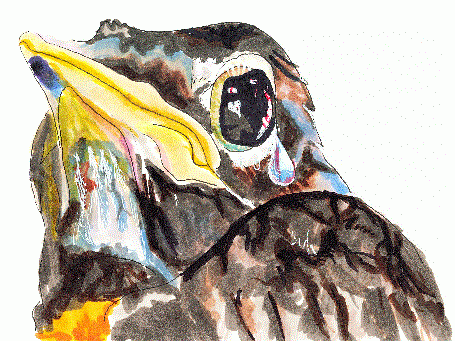

There are many ways I could start today’s post, but let’s aim for the concrete and immediate: I hope to bring out a book this year (intended release date 7/15, but I’m vacillating: do I need more revision time and fallow time to deepen and strengthen it? will I give into convention and look for a traditional publisher?).
This book is called Out of Tales. It weaves together work in many genres: heavily fictionalized memoir, essay, poetry, visual art, and fantasy narrative (globally, the beginning of the tale of the absorption of a nameless, dull Kingdom into Evernost, the fae realm beyond; locally, the twisted tale of three magicians who speed the process in spite of themselves). It’s at times (as one of said magicians says about his first love) hopelessly pretentious — a peculiar and chaotic hodgepodge I still fear is held together with little more than duct tape and prayer — and the first full-length book I will bring out as part of Of Evernost.
To those of you not familiar, Of Evernost is the enormous, amorphous writing / art project to which I devote most of my free time. Born as a fantasy novel, it has evolved into an abusive agnostic romance with God. If you think that sounds strange, you’re right, and that may assign it the wrong kind of seriousness.
For me (and, I have the sense, for many writers, particularly Romantic and adjacent), fantasy (mythology, imagination) and much of the literature of religion (many religions!) scratch the same itch, and in this work I give myself permission to scratch that itch (and pretty much any other that arises). In another age, I’d probably believe; today I hope, rather, but where this work is concerned that’s beside the point. It’s somewhere between escapism and a thought experiment: what if reality were inarguably something so splendid as to deserve our fealty? Beyond splendor I don’t commit to much (it’s not Christian, for example, though Christian thought is an inspiration, and I advance theologies only as wild speculations).
But that is too abstract, and having flashed it at you, I must ask you to set it aside. Why? Well, Evernost is a lot to keep track of, and one of the — organizing structures — I most enjoy is the Year. I draw some inspiration from literary critic Northrop Frye’s Anatomy of Criticism here. In his system, satire is of winter, comedy of spring, romance (in the medieval sense) of summer, and tragedy of autumn. My system is not that straightforward, but winter is a time of desolation, and the month of January in particular (I write from the northern hemisphere) is, among other things, a time of the prosaic and ugly, ordinary life at its least inspiring — and the quest to find value even there.
Out of Tales is of January. Like a fairy tale, Of Evernost begins (in theory) with its least inspiring material, with the everyday world, with only glimpses of what is more. It tries to transform that material, but perhaps it can be forgiven if it fails, not just because this is my first Real Book, and an ambitious and experimental one at that, but also because January is also the month of false awakenings and false starts.
Over the following weeks, I plan to write more about the disparate parts of Out of Tales, the creative process, and why a reader might want at least to give it a try.
 Of Elsewhere